When you ask Anthony Dorsi what matters most after nearly four decades on the job, he doesn’t reach for big slogans or sweeping gestures. He keeps it simple: “Show up on time. Do your job.” It’s the kind of plainspoken wisdom that has carried him through 37 years with Laborers Local 731—and across some of the most consequential transportation projects in the New York region.
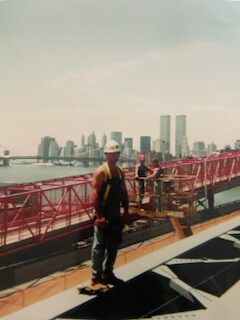
Dorsi works for RailWorks, the firm behind track installation and maintenance for the New York City Transit Authority, the Long Island Rail Road, and Amtrak. If you’ve ridden the 7 train from Times Square to Hudson Yards, his work helped make that trip possible. If you’ve watched the Second Avenue Subway reshape the East Side—especially the open-cut phases from 63rd Street to 96th—his hands were part of that history. If you’ve navigated the city through the cavernous new East Side Access connections, or marveled that the Brooklyn Bridge still flexes and breathes with the daily pulse of the city, the expansion joints Dorsi worked on are part of your story too.
For Dorsi, the reason to keep lacing up his boots goes beyond steel and ballast. “My family is why I come to work every day,” he says. “My wife, my kids—this union has helped me take care of them.” That clarity of purpose—family first, work done right—has shaped his career and his reputation. Colleagues talk about his reliability; supervisors mention his steadiness under pressure. Dorsi prefers another word for it: pride. “You feel it when a train rolls over track you set,” he says. “You know people are getting to work, to school, home to their kids—because you did your part.”
The Craft You Don’t See—But Always Feel
Rail work rarely gets the spotlight, but nothing in a rail system functions without what Dorsi calls “the quiet craft”: grading sub roadbed to exacting tolerances; setting sleepers and fastening systems; aligning rail to fractions of an inch; managing welds, expansion gaps, drainage, and vibration isolation so trains glide safely at speed. On landmark projects like the 7 Line Extension and East Side Access, the schedule demands were relentless, the logistics complex, and the standards unforgiving. Track crews are often among the last to touch a corridor before the public returns, a truth that concentrates responsibility.
“People think it’s just laying down steel,” Dorsi says, “but it’s problem-solving—minute by minute.” Weather changes the plan. Deliveries arrive late. Geology surprises you. Sometimes you swap tasks in the field because that’s what the job calls for. “You rely on each other,” he adds. “You learn to think three moves ahead.”
That reliance is a theme Dorsi returns to again and again. He considers his RailWorks team a “tight-knit family,” a phrase that might sound like a cliché until you’ve spent a night shift together troubleshooting a stubborn alignment in freezing wind, or hit a curve’s sweet spot just right and felt a whole crew exhale with satisfaction. “You look after your partner because your partner looks after you,” Dorsi says. “That’s the rule.”
Brotherhood, Benefits, and the Backbone of a Career
Dorsi credits Laborers Local 731 for the durability of his career and the security that underpins his home life. “It’s a brotherhood,” he says. “A family, really. The union fights for us—our medical benefits, our pension. That’s how you plan a life.” He extends special thanks to Carmine Damato (Business Manager), Dominic Valdner (Secretary Treasurer) and Giovanni Laucella (President) and the rest of 731 leadership past and present for “building a strong union” and setting a standard of service to the membership that, in Dorsi’s view, “raises everyone’s game.”
That stability shows up in practical ways. A union contract turns unpredictable project timelines into predictable pay and benefits. Training and certifications keep workers safe and systems compliant. Pension credits accumulate year after year. And in moments of personal challenge, a union hall can feel like a second home—an anchor that keeps a worker and their family from drifting when unforeseen currents hit.
“People talk about dignity at work,” Dorsi notes. “To me, dignity is knowing the job is tough but fair, that you’ll be treated with respect, and that when you put in the work, you can take care of your own.”
Local 731: Building the City Beneath the Headlines
Laborers Local 731 is part of the Laborers’ International Union of North America (LIUNA), representing men and women who do the heavy lifting of urban infrastructure across the New York metro area. While the public often recognizes the finished bridge or the ribbon-cut station, Local 731 members do the essential tasks that make those moments possible: site work, excavation support, concrete and utility preparation, demolition and debris handling, and specialized scopes that support rail and transit systems. Their jurisdiction brings them into daily partnership with contractors and agencies on projects that keep the city’s economic heart beating.
What distinguishes Local 731 is not only the breadth of its work but the union’s commitment to three pillars:
- Safety and Training. Through structured training and ongoing certifications, members learn to navigate complex sites and evolving technology—protecting themselves, their crewmates, and the public.
- Wages and Benefits. The union secures fair pay, comprehensive medical coverage, and a pension—benefits that echo across families and neighborhoods, turning blue-collar grit into multigenerational stability.
- Solidarity and Service. From steward support to community engagement, Local 731 emphasizes that labor power is people power—workers standing together to improve conditions on the job and quality of life off it.
That mission has never been abstract to Dorsi. It’s as specific as a prescription covered, a dental appointment kept, a pension statement that adds up. “You can work with your head up,” he says. “You’re not guessing what next month looks like.”
Lessons from the Long Haul
Ask Dorsi what he tells younger members and he doesn’t hesitate:
- Show up early. “On time is late,” he laughs. “When you’re early, you’re calm. You plan your day. You’re ready when the whistle blows.”
- Do your job—then a little more. Initiative gets noticed. “If you can help a partner wrap a task, do it. That’s how crews become teams.”
- Respect the craft. Every cut, every bolt, every measurement matters. “If you treat the work like it matters, it will treat you right back.”
- Learn from everyone. “You don’t have to pretend you know it all. Ask. Watch. A good question can save an hour.”
- Remember who you’re doing it for. For Dorsi, that’s family—and the traveling public. “Real people depend on what we build.”
Those lessons have a way of compounding. Show up early and you earn trust. Do your job and a little more, and you get responsibility. Respect the craft and your work lasts. Learn from others and your skill set grows. Remember your “why,” and the tough nights make sense.
Pride, Gratitude, and the Tracks Ahead
Dorsi’s voice softens when he talks about the people who shaped his journey—foremen who taught him to slow down before speeding up, stewards who squared away problems without fanfare, union leaders who fought for benefits members could count on. He talks about the first time he walked a finished run of track with a senior hand who quietly pointed out what most eyes would miss: the way a curve transitions, the sound of a joint under load, the feel of a good line under your boots. “He told me, ‘When you’re done, look back at what you’ve built. That’s yours.’ I never forgot that.”
There’s pride, too, in the places the work has taken him—the elbow-to-elbow nights under the East River, the wind-cut scaffolds on the Brooklyn Bridge, the dawn shifts when the city creaks awake and the rails gleam with the first light. “You earn your tired at the end of a day like that,” he says. “That’s a good tired.”
As he reflects on 37 years, Dorsi is clear-eyed about what’s changed—technology, safety culture, the complexity of megaprojects—and what hasn’t: the need for dependable people who show up ready. “If I had to boil it down,” he says, “it’s the same two rules: be on time, and do your job.”
The Measure of a Career
There are countless ways to measure a working life. You can tally years and jobs, count certifications, list projects and contractors. Or you can take the Dorsi measure: the good you leave behind. Tracks that carry a city. Crew members who learned to lead. A household cared for. A pension that will pay when the knees finally say enough. A union kept strong for the next generation.
“The union changed my life,” Dorsi says simply. “It gave me a path. And when you’ve got a path, you can walk it with your head up.”
That, more than anything, is the legacy of a Local 731 laborer who set his standards early and never put them down. Show up. Do the job. Take care of your own. In a city that runs on rails and heart, that’s a blueprint worth celebrating.
Fast Facts: Anthony Dorsi
- Union: Laborers Local 731 (LIUNA)
- Employer: RailWorks
- Years of Service: 37
- Signature Projects: 7 Line Extension (Hudson Yards–Times Square), Second Avenue Subway (63rd–96th Street open cut phases), The Williamsburg Bridge, East Side Access, Brooklyn Bridge expansion joints
- Guiding Principles: Punctuality, hard work, pride in craft
- Why He Works: “My wife and kids are my motivation.”
- Union Impact: “A brotherhood and a family—fighting for our medical benefits and pension.”
About Laborers Local 731
Laborers Local 731, part of the Laborers’ International Union of North America, represents skilled construction laborers across the New York metropolitan area. Members power the essential work that keeps the region moving—site preparation and support for major infrastructure; demolition and debris handling; utility and concrete work; and specialized scopes that underpin rail and transit projects. Local 731 is known for its commitment to safety and training, bargaining for strong wages and benefits, and a deep tradition of solidarity and service to its members and their communities.